Did You Know?
THERE ARE:
359 breedable Newfoundland Ponies. That number is a combination of Mares born 2002 & after, and Stallions born 1998 & after.
220 of these breedable ponies currently have no foals on the ground. Some are bred for 2026. Some are too young. Some ponies are not yet registered by the Newfoundland Pony Society.
141 of these breedable ponies have had foals.
Please note - the information given is the most accurate available at the time of writing but may not include unreported deceased or gelded ponies.
The Number of Descendants of each of the 13 Foundation Stallions are as follows:
JOE BATTS BLAZE - 12
RUSTY - 35
LITTLE BO DANDY - 39
KEIFFER - 51
BLAZE OF BELLE - 54
BLACK BRANDY - 77
CHAMPION K - 81
DANCEY - 96
VINLAND’s STAR OF THE SEA - 112
ADMIRAL SHALLOWAY - 144
SKIPPER OF AVALON 147
VINLAND’s RUSTY OF THE BLACK RIVER - 167
PRINCE TAMARACK - 169
The Newfoundland Pony Conservancy is pleased to announce a FREE Newfoundland Pony breeding analysis service for registered Newfoundland Pony owners/breeders. Owners/breeders simply need to email us at info@newfoundlandponies.org with a pony's name and registration number. We then run the program to show inbreeding coefficients between that pony and all of the registered, breedable Newfoundland ponies. NPCC will then email back a pdf with all the matches, both good and bad.
This free service is part of NPCC’s educational mission to help everyone make good breeding choices. Informed breeding is crucial to the future of the breed to prevent bottlenecks and genetic problems developing which would increase the possibility of extinction of the true traditional pony of Newfoundland. That unfortunate scenario has played out in other rare breeds.
Please note that all of the data is publicly available. NPCC is not responsible for any errors. It is the responsibility of the breeder to check pedigrees.
Also, be aware that an Inbreeding Coefficient is just one tool in the breeder’s toolbox. Here are others:
To maintain genetic diversity it is particularly important to make sure that ponies descended from the rarer lines are bred and that we don’t lose ANY of the lines. As you can see, currently there are many foundation stallion lines with low numbers of descendants.
Doubling up on any of the lines will increase the inbreeding coefficient, increasing risk of genetic issues.
Keeping inbreeding coefficients as low as possible helps safeguard the future of the Newfoundland pony. Highly inbred animals are less fertile, less healthy, and have reduced genetic diversity.
Genetic diversity is finite and easily lost. Use it or lose it!
Maximize the breeding population by breeding ponies that have not yet produced foals.
Make sure the rarer stallion lines survive for the breed's future.
It's important that a mare is bred to more than one stallion.
It's important to maintain some ponies that don’t carry the commonest lines so that they (and their descendants) can be used to outcross in the future.
Always look at pedigrees all the way back to foundation - a 4 generation pedigree can conceal earlier inbreeding.
Most of the time we consider stallion lines but mare lines are of equal (if not more) importance.
HERE IS A SAMPLE OF WHAT YOUR BREEDING REPORT FROM US WILL LOOK LIKE:
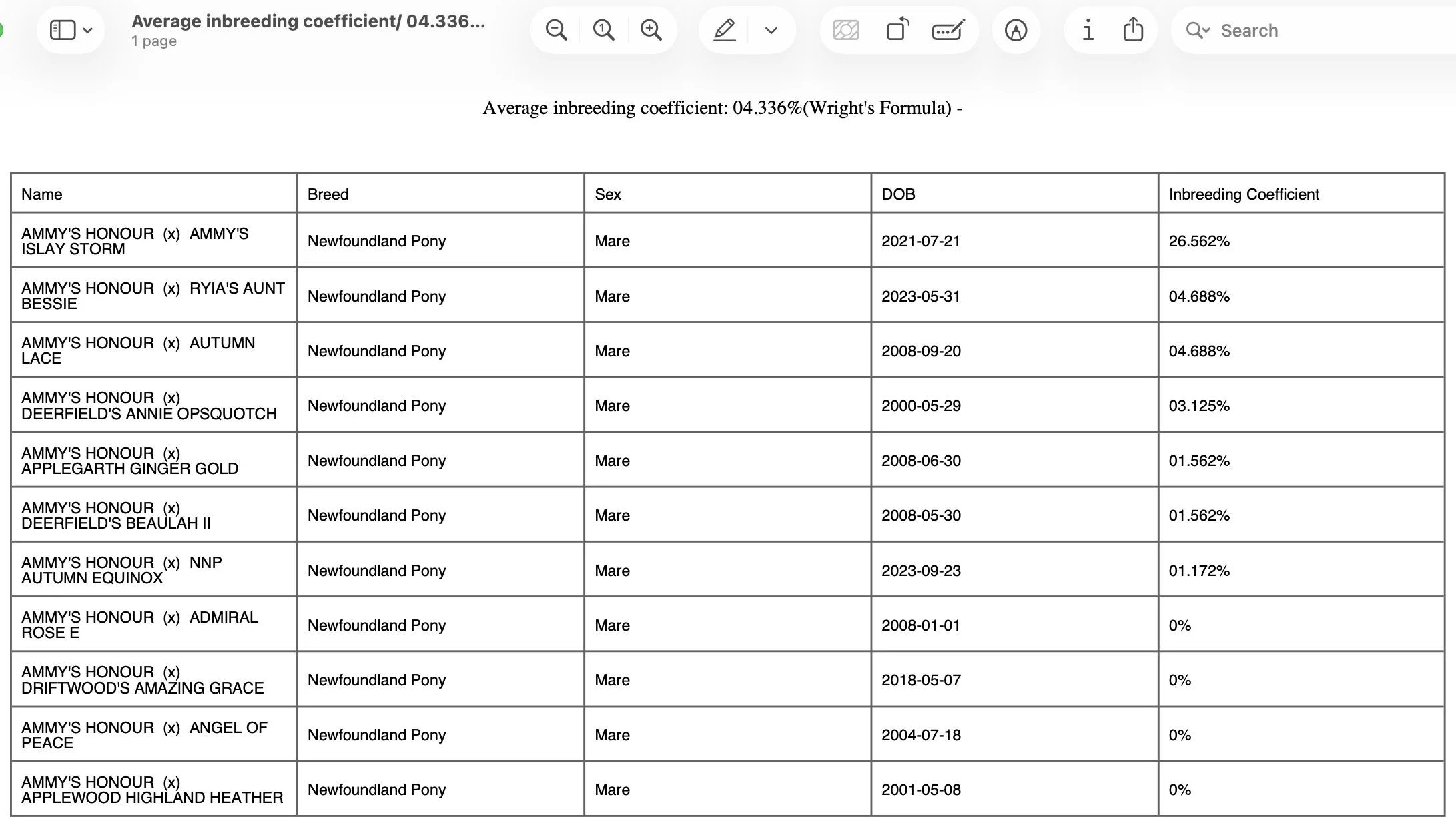
This is just a short sample of what you will receive. Your results will include all of the opposite sex breedable ponies in the registry and it will be multiple pages. Of course 0% coefficient is best. Our max limit is 5% and that would be only if absolutely necessary, ie no other matches available for a particular pony.